
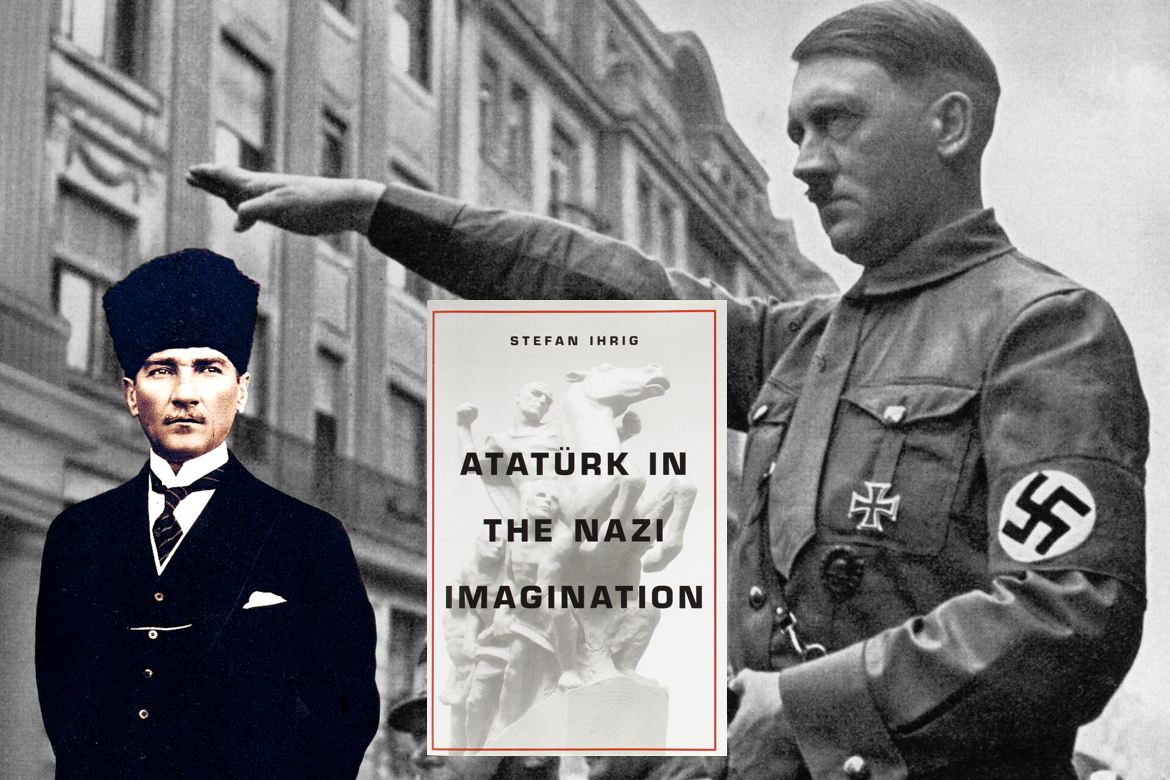
It is a well-documented fact that early in his career, Adolf Hitler took inspiration from Benito Mussolini, his senior colleague in fascism.
But an equally important role model for Hitler and the Nazis has been almost entirely neglected: Mustafa Kemal Ataturk, the founder of modern Turkey and perpetrator of one of the most horrific episodes of ethnic cleansing and genocide against his non-Turk populations.
The historian Stefan Ihrig’s compelling book “Ataturk in the Nazi Imagination” outlines and meticulously documents this largely unknown story. This work also promises to rewrite our understanding of the roots of Nazi ideology and strategy.
Hitler was deeply interested in Turkish affairs after 1919. He not only admired but also sought to imitate Ataturk’s radical construction of a new nation from the ashes of defeat in World War I.
Hitler and the Nazis watched closely as Ataturk defied the Western powers to seize government, and they modeled the Munich Putsch to a large degree on Ataturk’s rebellion in Ankara.
Hitler later remarked that, in the political aftermath of WWI, Ataturk was his master while he and Mussolini were his students.
This was no fading fascination. As the Nazis struggled through the 1920s, Ataturk remained Hitler’s “star in the darkness,” his inspiration for remaking Germany along nationalist, secular, totalitarian and ethnically exclusive lines.
Nor did it escape Hitler’s notice how ruthlessly Turkish governments had dealt with Armenian and Greek minorities, whom influential Nazis directly compared with German Jews. The New Turkey, or at least those aspects of it that the Nazis chose to see, became a model for Hitler’s plans and dreams in the years leading up to the invasion of Poland.
Christopher Clark, professor at the University of Cambridge, said:
“From the Armenian massacres to the Turkish War of Independence and the rise of Kemal Ataturk, Turkish events attracted deep interest in Germany. As Ihrig shows, politically active Germans of the Weimar Republic, especially on the far right, saw in Turkey a model for successful revisionism, authoritarian rule, secular modernization and the political utility of genocide. This brilliant and original study sheds new light on the rise of Nazism and the pre-history of Nazi racial policy.”
Order your copy of “Ataturk in the Nazi Imagination” by clicking here