
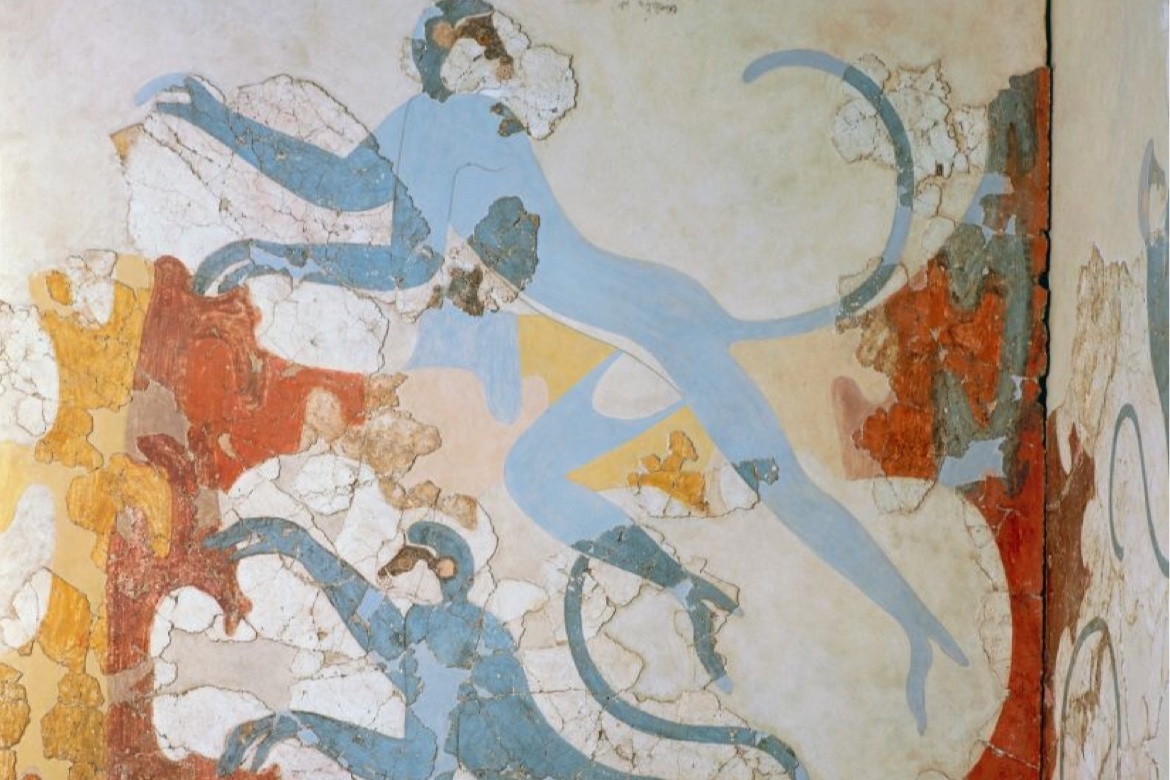
A well known Bronze Age fresco on a Greek island shows a monkey from thousands of miles away in Asia, suggesting that ancient Greeks were traveling, trading and exchanging ideas with cultures much farther than previously believed.
The artwork is one of several wall paintings in a building at Akrotiri on the Greek island of Santorini in the Aegean Sea.
Akrotiri was a settlement of the Minoan civilisation in Bronze Age Greece that was buried by ash from a volcanic eruption in around 1600 BC.
Many of the paintings in Bronze Age antiquities show monkeys, yet there were no monkeys in Greece at the time.
Most of the monkeys have been identified as Egyptian species like olive baboons — which makes sense since Egypt was in contact with the Minoan civilization — spread across several Aegean islands.
Other monkey species were harder to identify.
Marie Nicole Pareja at the University of Pennsylvania in Philadelphia teamed up with primatologists to re-examine the mystery monkey paintings — one of which stood out.
“When they looked at this wall painting, they all straight away unambiguously said ‘that’s a langur’,” Pareja said.
According to their research and findings, the team has identified the monkey in the Santorini frescos as a grey langur (Semnopithecus).
As well as its distinctive fur, the monkey was depicted holding its tail in a characteristic S shape.
Grey langurs live in southern Asia in what is now Nepal, Bhutan and India — particularly in the Indus Valley.
During the Bronze Age, the region was home to the Indus Valley civilization, one of the most important of that time. Although it was past its peak, the Indus Valley civilization was still advanced for the era due to its large cities and elaborate water supply systems.
Somehow, the artist who painted the monkey picture must have seen a grey langur. But how? Did Minoan Greeks visit the Indus?
“I wouldn’t be surprised if someday in the future we found evidence for that kind of direct contact,” Pareja said, “But right now there is none.”
Instead, it may be that Greece and Indus were connected via Mesopotamia, another Bronze Age civilization centered on what is now Iraq. Langurs may have been imported to Mesopotamia for menageries, where visiting Greeks saw them.
“It’s evidence of this far-reaching trade, these relationships with these far-flung areas,” Pareja said.
Even in the Bronze Age, it seems there was a lot of exchange between seemingly separate civilizations.