
The following story by James S. Scofield was published in numerous newspapers on the 75th anniversary of the American Hellenic Educational and Progressive Association (Ahepa) in 1997. The story, republished here, is a sobering reminder of the struggles Greek immigrants to the United States and Canada faced when they arrived in the New World.
***
It was 1922, Americans of Hellenic heritage were suffering personal and economic intimidation orchestrated by the revived Ku Klux Klan. It was time for them to unify and organize, to protect and defend life and livelihood.
The widespread and often violent discrimination against immigrants from Greece is an almost forgotten page of American history. This is probably because of their subsequent success and the great accomplishments of their descendants. Very few persons today, Hellenic or not, are even vaguely aware of the massive continental strength of the Klan of the 1920s and its intensive persecution of foreign-born Greeks, including those who had chosen to become American citizens.
They do not know how deeply the evil shadows of bigotry, hatred and intolerance cast their malignant darkness over North America. Perhaps it is time to remind them.
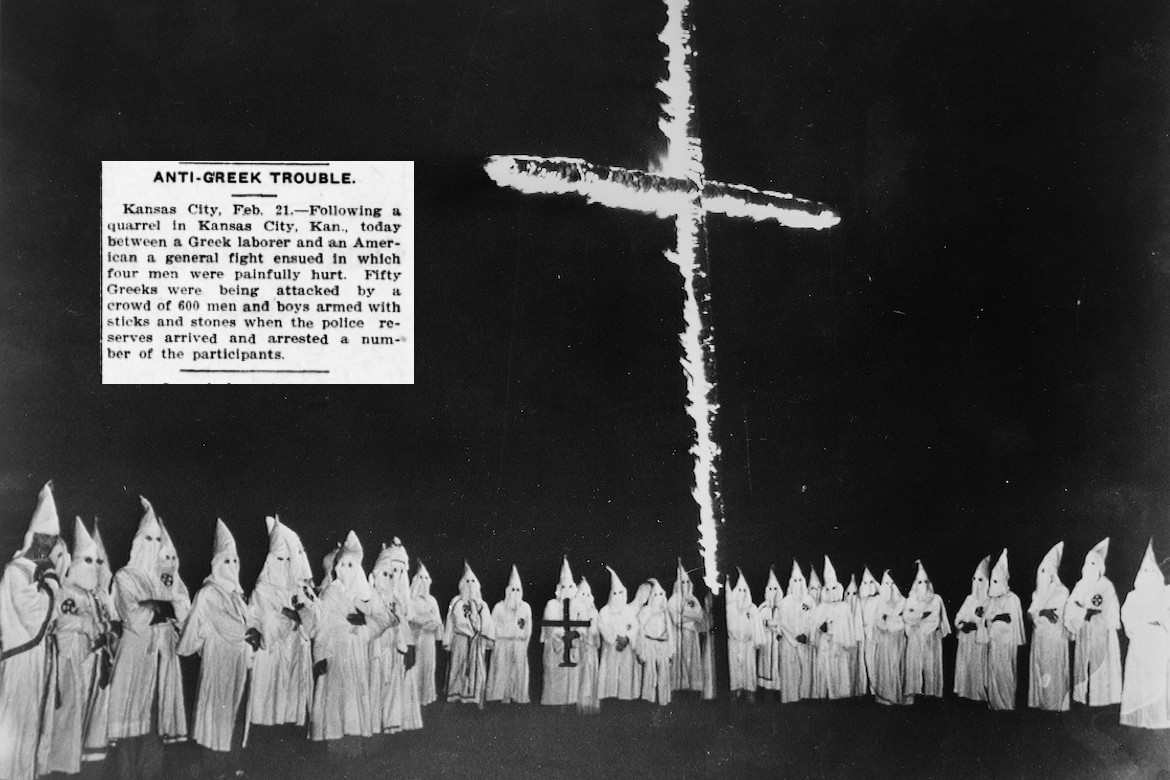
The newly-reorganized KKK rampaged against frightened immigrants and helpless minorities throughout the U.S. It dominated politics in states in both the North and South. In Canada, its dangerous wicked ways were transplanted and flourished, especially in the western provinces.
An estimated three million militant hooded Klansmen stalked across our continent, burning crosses and spawning terror.
During its reign of power, the Klan elected sixteen U.S. Senators, eleven Governors and an undetermined large number of Congressmen, both Republican and Democrat. It reportedly exerted considerable influence in the White House.
Klan organizations ruled local politics in the major cities of Dallas, Denver, Indianapolis and Portland, Oregon, as well as in such smaller communities as Anaheim, California; El Paso, Texas; Youngstown, Ohio and Portland, Maine.
In 1902, California and Oregon voters elected Klan-endorsed gubernatorial candidates. Then in 1924, a Klan candidate won the governorship in Kansas. The same year, the Klan endorsed U.S. Senate winners in Alabama, Colorado, Georgia, Indiana, Oklahoma and Texas. It also won the gubernatorial contests in five of these six states, barely losing in Texas.
At U.S. election polls, Klansmen passed out cards which crudely and defiantly declared:
When cotton grows on the fig tree
And alfalfa hangs on the rose
When the aliens run the United States
And the Jews grow a straight nose
When the Pope is praised by every one
In the land of Uncle Sam
And a Greek is elected President
THEN–the Ku Klux won’t be worth a damn.
Meanwhile, embattled but visionary Greek immigrant leaders met on July 26, 1922, in Atlanta to form the American Hellenic Educational Progressive Association, now better known as the Order of Ahepa. Not by coincidence, Atlanta was the home of the national Imperial Headquarters of the Klan.
The most important goal of the Ahepa founders was to quickly and solidly establish better relations with non-Greeks. They agreed to do this by taking the positive high road of reason emphasizing assimilation, cooperation, persuasion and unlike their marked foes, non-violence.
Their main discussion was how to best contain the wave of hostility which had almost drowned them. The ominous specters of twisted Americanism and KKK aggression spurred them to create a patriotic fraternal order espousing undivided loyalty to the United States. American citizenship, proficiency in English, active participation in the civic mainstream, economic stability, social unity and the pursuit of education. The latter was considered vital for its obvious gifts of knowledge and as the essential key to upward mobility.
The Ahepa founders were profoundly disturbed and alarmed by their bitter experiences with Klan prejudice and by reports of worse bigotry elsewhere. Even before the Klan reappeared, there had been senseless attacks on foreign-born Greeks, some fatal. However, the new Klan expertly and abrasively honed intolerance with brutal efficiency to silence and subdue all of its alleged inferiors.
Many Greek-owned confectioneries and restaurants failed financially or were sold at sacrificial prices to non-Greeks because of boycotts instigated by the Klan. Greek establishments doing as much as $500 to $1,000 a day business, especially in the South and Midwest, dropped to as little as $25 a day. The only recourse was to sell or close.
The Klan often bolstered its boycotts by openly threatening or attacking customers entering and leaving.
A Klan Imperial Lecturer told Klansmen in Spokane that Mexicans and Greeks should be sent back to where they came from so that white supremacy and the purity of Americans be preserved. Meanwhile, in Palatka, Florida, a Greek immigrant was flogged for dating a “white” woman.
The Royal Riders of the Red Robe was a Klan affiliate assembled “as a real patriotic organization” for approved naturalized citizens unluckily born outside the United States. However, in the ultimate snub of exclusion, immigrants from Greece, Italy and the Balkans were not eligible to join.
In Indiana, the state most politically controlled by the 1920s Klan, burning crosses were ignited in the yards of outspoken Hellenes. Unprovoked beatings of Greeks were not reported to police lest another beating soon follow. Others were warned of dire consequences if they spoke Greek in public, even in their own business establishments.
Hoosier Democrat and Republican leaders actively discouraged naturalized Hellenes from filing for public office, forcing them to run as Socialist Party candidates. Fearful Greek Orthodox Christians indefinitely postponed impending plans to organize parishes. To avoid constant confrontation, long and difficult to pronounce first and last names of Greek origin were shortened or changed to more acceptable Americanized versions. False rumors spread by the Klan about supposed unsolved murders of Greeks in other states produced the desired dread.
The Klan Grand Dragon of Oregon said in a spirited speech in Atlanta: “The Klan in the western states has a great mission to perform. The rapid growth of the Japanese population and the great influx of foreign laborers, mostly Greeks, is threatening our American institutions; and, Klans in Washington, Oregon and Idaho are actively at work to combat these foreign and un-American influences.”
Probably the most blatant hard-line bullying, almost humorous, occurred in Pensacola, Florida. A Klansman handed a note to a Greek restaurateur which read: “You are an undesirable citizen. You violate the Federal Prohibition Laws and laws of decency and are a running sore on society. Several trains are leaving Pensacola daily. Take your choice but do not take too much time. Sincerely in earnest, KKK.”
Today, according to sociologist Charles C. Moskos, Jr., of Northwestern University, American Hellenes proudly rank first among all ethnic groups in individual educational attainment and second in individual educational attainment and second in individual wealth. They have succeeded in every facet of American life. The Order of Ahepa has played the prime historic role in this ascent.
True to its original mission, Ahepa financially supports scholarships, educational chairs, housing for the elderly, medical research, community programs, charitable projects and other worthy endeavors through contributions of more than two million dollars a year from its chapter, district and national levels.
Ahepa validated its patriotic roots during World War II by selling over five hundred million dollars of U.S. War Bonds, more than any organization in America. Meanwhile, Ahepa officials first visited the White House to meet with President Calvin Coolidge in 1924 and have conferred with all twelve Presidents since Presidents Franklin Roosevelt, Harry Truman and Gerald Ford became Ahepa members.
More recently, Ahepa raised $400,000 for the restoration of Ellis Island and the Statue of Liberty and $775,000 for a sculpture commemorating the Centennial Olympic Games in Atlanta. Ahepa has received congressional and presidential recognition for promoting friendship and goodwill among the people of the United States, Canada, Greece and Cyprus. President George Bush hailed Ahepa as one of “the thousand points of light.”
Ahepa moved its headquarters to Washington DC in 1924 and later expanded its scope by adding three auxiliaries to complete the Ahepa Family: the Daughters of Penelope for women, the Sons of Pericles for young men and the Maids of Athena for young women. Its combined eight hundred chapters, consisting of about 35,000 members, cover the United States and Canada and have planted successful units in Australia and Greece. It held its 75th annual convention in Atlanta in August.
In 1990, Ahepa filed an amicus curiae (friend of the court) brief in the Georgia Supreme Court. It backed the legal position of the National Association for the Advancement of Colored People (NAACP) and the Anti-Defamation League (ADL) of B’nai B’rith in support of a state law banning masks in public which was challenged by the KKK. The court ruled 6 to 1 to uphold the constitutionality of the anti-mask statute.
The significance of the favorable decision to a jubilant Ahepa was that it came in the city of its founding and helped seal the doom of another failed Klan revival. Moreover, it enabled Hellenes to join in victorious celebration with fellow black and Jewish Americans whose forbearers also were sadistically harmed physically, mentally and economically by the KKK of yesteryear.
Along with Roman Catholics, Asians and other immigrants considered unacceptable by the Klan, they were targeted separately and together then because they did not fit the rigidly narrow KKK concept of what constitutes a good and loyal American.
For Hellenes, it is supremely ironic that the six organizers of the original Klan in 1865 created the words Ku Klux from kuklos, a variation of the Greek kyklos meaning cycle or circle, and applied it to their own little circle.
Today the 1920s version of the KKK is long gone–and its flickering reincarnations are virtual nonentities. The Klan deserved to die–and died. The Order of Ahepa thrives three quarters of a century after its historic birth amid the fiery heat of hate–generated by the toxic Klan cauldron of insane fanaticism. Ahepa deserves to live–and lives.
29 comments
.
Fortunately those Greeks did not live in the 21st century USA, where stalker gangs openly and notoriously stalk and poison people without fear of arrest – sometimes for over 18 years and sometimes fatally or close to it.
So perhaps the KKK is still here, different name and far more successful, since the media amd police and government are so beaten that they essentially ignore them.
Avraam Jack Dectis
My father came to the United STates at the turn of the twentieth century(1908) was educated at the University of Michigan an erudite Professor told him to anglicize his name if he wished to prosper in his new country, he so did. From Christodoulou to Christy and eventually ended up in Canada in the twenties. My birth certificate so states I am Christy with both parents born in Greece. It was a sad time where you had to give up your name to get ahead in life.
Your article about the KKK persecuting Greeks does not give any specific examples to support the claims. I don’t doubt that the KKK persecuted many minorities including Greeks.
I recognize the article was written many years ago. But specificity would help the impact of reading this article.
Tony Lymneos
Salem NH
Anthony, the said article was written by an Ahepa past president and former journalist and contained no sources, as sources normally don’t appear in such articles. Here’s another piece you might find interesting that is sourced. Thanks for the comment and thanks for reading! http://toto.lib.unca.edu/sr_papers/history_sr/srhistory_2012/gerontakis_steven.pdf
ANTHONY LYMNEOS specific examples would almost be impossible to list here my husbands father came here from Zakynthos and was part of the greeks that build the Montana railroads before WWI the lived and travels in the railroad cars as they build the tracks and they as well as the Italians and orientals as they were all segregated in different RR cars were set on fire as they slept at night. The AXEPA came out of this egregious and murderous behaviour by the KKK. My father in law was an eye witness to this and a member of the beginning of AXEPA and I was lucky to have him as mu father in law.
Lymneos you’re a KKK prick,fuck you
My grandpa and grandma were victims in 1924, in Springfield , Ill. Believe me it happened.. woke up to a cross burning in their yard.. left that next day for S. Louis
“The widespread and often violent discrimination against immigrants from Greece is an almost forgotten page of American history.”
Long live the AHEPA: What a proud history to defend the constitutional rights of all people, Greeks, Asians, Jews, Catholics and Blacks. God Bless the History of the these magnificent heroes of yester year.
God Bless America!
Cynthia Lucas
Dallas, Texas
What a great and informative article! This should become a must read by our youth. I am a proud member for 50 years, having served in almost every position of my chapter and I know first hand about how much the chapter has contributed to the church and the community! I repeat myself by saying the importance for our youth to learn our history so they can give credit and thanks for their present good luck!!!!
People of dark skin were not welcomed in those years…Greeks, Italians, Blacks, and I’m sure more. Something’s haven’t changed, and when change does come, it is slow. Still, respect for this great country should NEVER change.
Your uninformed stereotypical comment shows ignorance of facts Christine. Greeks, Italians are white, caucasians no different than the rest of Europe! My mother was blonde and blue eyed, I was born blond though my hair darkened at puberty. Mediterranean skin is darker on account of it being tanned from the sun. If you uncover the parts that don’t see the sun they are lily white! The issue is not skin color, other than for blacks unfortunately, it is the influx of a foreign culture that narrow minded people find threatening. If the Klan would take off their robes, they would discover most are “darkies” amoung their lot! How would you account for the persecution of the lily-whiteskinned Irish? Too white?
The founding of AHEPA had more to do with miscegenation than with anything else…..young single men of Greek origin were beginning to date young white women who worked in the Greek restaurants as waitresses. Revisionist history, Mr. Pappas. The only historian with the balls to write about this was Helen Zeese Papanikolas in her last work Rain in the Valley. Miscegenation was against the law in those days and well-established Greeks like the founders of AHEPA were being threatened by their “low-class” countrymen who just didn’t know the rules. The fact-free fiction dating back to 1972 was an attempt to polish up the mythology of a group who ended up being imitation Masons.
Dear Ms. Callinicos– the article was originally researched and written by Mr. James Scofield, a past Ahepa national president and Ahepa. Speak to him about your your claims of revisionism. Thank you and have a great day.
Since when are Greeks non-white, Ms. Callinikos? What are they, black, asian or latino? Have you checked the color of the skin you keep hidden? The issue is not that Greeks are non-white, but they brought a strange culture with them in sufficient concentrations of population to look like a threat to isolated areas of rural America.
My grandfather was one of the immigrants mentioned in this piece — one whose front yard in Muncie, Indiana, once had a cross burned on it by men in white hoods. Our family has not let this story die. My popou owned a local shoeshine stand and when he looked down at the feet of the hooded KKK haters in his front yard, he recognized them all by their shoes, calling them by name. He then proceeded to inform them that their children played together.
He was never threatened again, but even after this era, racism continued to flourish in this little Midwestern town. Perhaps not as outwardly, but it was there just the same.
We moved there from California when I was 9 years old. By high school age, I would hear some of my classmates talking as they walked by the family dry cleaner ridiculing my uncle, who had olive skin and kinky, dark hair, calling him “Bosco” — at the time the name of a chocolate mixture you poured into milk.
I was asked by a teacher about my family and realized by the smirk on her face as she asked it that the reason I did not get chosen for the high school chorus had nothing to do with my ability to sing.
Scratchy-voiced old women would walk up to the department store layaway window where I I was employed part time and ask where the “little girl” was. I looked at them, perplexed. I was the youngest employee in that department. Then I realized they were referring to the 50+ year old light-skinned black woman I worked with.
And my father, who owned a piano business and employed a piano tuner would sometimes be told to find someone else to tune their piano because they did not want a black man in their home.
It was there. It was always there. It just went underground, huddling itself around kitchen tables. Outwardly, it remained as ugly expressions on faces that heard strange accents, recognized foreign faces, or hated religions not their own. And now it’s simply coming out of hiding. And the KKK is leading the procession of Nazis and “white” supremacists….
In the 1930’s my mother pretended to be French, as she was fluent in the language, because Greeks were discriminated against. In the 1950’s, my teacher said to me, in front of the class, “Greek? What’s that? What kind of food do you eat??” In my little voice I said “hamburgers” because my father was also a proud veteran of WW2, and wanted his children to live the American dream while also honoring our heritage. To this day, I can remember her look of distaste at me. And you’re correct Dena, these feelings are coming to the surface again in our great country, and we have an incompetent leader who cannot, or will not protect us. But, Nevertheless We Will Persist. Peace.
Interesting
Dena Kouremetis,
It is important that as we come down through the generations, the immigrant history is preserved. The unpleasant parts along with the good create a total story of hardship, perseverance, faith and honor. We need to strive to achieve the standard of our grandparents.
Here in the USA, we see discrimination and bullying to extremes. We have not learned our lessons.
Thank you for sharing.
MaryJo Cally
My grandfather immigrated from Greece in the early 1900’s. My mother spoke about cross burnings in the small mining town in Utah where she grew up. Thank you for this story.
My grand parents immigrated to Charleston West Virginia from Crete Greece and I remember when I was a child my grandma telling me how they used to watch the hooded Klansmen parade up and down their street at night with their torches trying to intimidate them. They wouldn’t dare walk outside at night from fear of being lynched.
What a testimony to the perseverance of my Greek grandparents and their fellow immigrants! I don’t know if my yia-yia and papou were victims of white supremacist discrimination when they lived in Canton, OH and Detroit, MI. But, I do know that my papou was president of the AHEPA chapter in Detroit, and that he had been threatened by a local union thug because he hired black men to work for him in his produce business. When the thug tried to overturn my papou’s truck, Papou beat the crap out of him. The thug’s name was Jimmy Hoffa.
ANTHONY LYMNEOS read ZEESE PAPANIKOLAS’ “BURIED UNSUNG” which spells out typical KKK harassment of Greek-immigrants. You emulate numerous Greek-Americans who do not research nor read about the terrible conditions and harassment of our hardy forefathers .
When I was young I recall signs on windows “HELP WANTED DOGS OR GREEKS NEED NOT APPLY”.
With all humility as a Greek-American I was one of 156 Greek-Immigrant and Greek-Americans volunteers who joined OSS’s Greek/American Operational Group and subsequent operated behind enemy (Nazi) lines in Greece, and please don’t tell me Greeks did not suffer during WWII, or there were no American boots in Greece.
If you are Greek? you should be ashamed Mr. LYMNEOS
Andrew S. Mousalimas
I am proud for you about your grandfather. Yes he was a Great American.
My Dad Pete Lucas Sr., from Dallas, Texas was a British Intelligence Officer in the United States Army Air Force. Then became an American Intelligence Officer in the Air Force. Greeks were in the death chambers like the Jews in the Holocaust. God save their soles. Yes America is a great country. My parents were both born in Dallas, Texas. My grandparents from both sides were born in Greece. Yes a proud Greek American I am.
Such an enlightening article! I knew of immigrant descrimination, but not this level.
Thank you all for your great family stories of perseverance.
Thank God for all of the immigrants as they bravely fought bigotry and hate. Thank you for Ahepa and why it was formed. We still have a long way to go as we still see evil by the KKK. Things like this were going on when Christ was here living among us and even before that . May Christ have mercy on us as we continue to fight the good fight to stamp out hate.
Anna Argyres Losey
[…] 2017, Dena Kouremetis, the daughter of one of the Greeks targeted by the KKK posted her memories after the white supremacists attack in Charlottesville, […]
The first Greek churches were build by Benakis at New Orleans and Mobile, Catholic, Franco-Spanish ports
used for slave trading. The slaves came here with Greek ships, under other flags. The word Ku Klux Klan
comes from the Greek word Kuklos or Cyclos. The south was the source of modern fraternities and neoclassical
architecture, which emulated the Greeks while the north emulated Rome and Harvard degrees are still in latin.
Greeks preferred to live in the south and Jefferson learned Greek from a Greek named John paradise.
https://www.ludwell.org/john-paradise-jeffersons-greek-tutor